

How to Navigate Tax Implications When Buying, Selling, and Inheriting Collectibles
Key Takeaways
- 01Take our free, 2-minute Sports & TCG Card Sales Tax Optimizer Quiz to score your tax and planning collection preparedness.
- 02Collectibles are subject to a maximum 28% capital gains tax rate, higher than the standard 0%, 15%, or 20% rates for other investments
- 03Step-up in basis upon inheritance can eliminate capital gains taxes for heirs receiving collectibles
- 04Like-kind exchanges (Section 1031) and charitable donations offer potential tax-efficient strategies for collectible holders
- 05Professional flippers of collectibles like Pokémon cards must treat profits as ordinary income subject to self-employment taxes
- 06Proper documentation and record-keeping are essential for establishing cost basis and holding periods for tax purposes
The collectibles market has experienced unprecedented growth in recent years, with sports cards, Pokémon cards, and other memorabilia reaching record-breaking prices. However, what many collectors don’t realize is how these valuable assets are treated differently under the U.S. tax code compared to traditional investments like stocks and bonds.
Understanding the tax implications of buying, selling, and inheriting collectibles is crucial for anyone with a significant collection. The IRS treats collectibles as a special category of investment, subjecting them to unique capital gains rates and complex regulations that can significantly impact your financial planning.
Whether you’re a casual collector who inherited your grandfather’s baseball card collection or an active trader flipping Pokémon cards for profit, knowing how to navigate these tax rules can save you thousands of dollars and help you make more informed decisions about your collecting activities.
Understanding the Meaning of Capital Gains Tax on Collectibles
The IRS defines collectibles under Section 408(m) to include a wide range of tangible personal property such as art, antiques, stamps, coins, sports memorabilia, trading cards (including Pokémon cards), alcoholic beverages, and precious metals. According to the dictionary, a collectible is defined as an item valued and sought by collectors. In the tax code, 'collectible' is used as a noun to describe these items. When you sell these items, the way capital gains are calculated and taxed differs significantly from other investments. This section addresses the question of how collectibles are taxed and what rules apply.

When you sell a collectible, what happens is that the IRS treats the gain differently than other assets. The action of selling or trading a collectible triggers a taxable event, and you must report the gain or loss on your tax return.
For collectibles held longer than one year, the maximum federal capital gains tax rate is 28%, substantially higher than the 0%, 15%, or 20% rates that apply to most other long-term capital assets. This higher rate can have a dramatic effect on your tax liability, particularly for high-value items, and the extent of the tax can significantly reduce your net proceeds. Tax liability is measured based on the difference between your sale price and your cost basis.
Short-term collectible gains (items held for one year or less) are taxed as ordinary income, which means rates can reach as high as 37% for high earners. The meaning of this distinction becomes clear when you consider the financial impact: a collector who sells a first-edition Charizard Pokémon card purchased for $1,000 and sold for $10,000 after holding it for more than a year would face a maximum federal tax of $2,520 (28% of the $9,000 gain), not including potential state taxes or the Net Investment Income Tax. The degree to which these tax rates affect your profits depends on your income bracket and holding period. The manner in which gains are realized—whether short-term or long-term—determines how they are taxed.
To illustrate how this works in practice, consider these examples:
Collectible Type | Purchase Price | Sale Price | Holding Period | Tax Rate | Tax Owed |
|---|---|---|---|---|---|
1952 Mickey Mantle Card | $5,000 | $25,000 | 3 years | 28% | $5,600 |
PSA 10 Charizard | $500 | $8,000 | 6 months | 37% | $2,775 |
Vintage Baseball Set | $2,000 | $15,000 | 5 years | 28% | $3,640 |
You can use these figures to score your gains or losses and better understand your tax obligations.
The distinction between collectibles and traditional investments becomes even more apparent when you factor in the Net Investment Income Tax (NIIT), an additional 3.8% surcharge that applies to investment income for high earners. This can push the effective tax rate on collectible gains to nearly 32% for wealthy collectors.
The IRS uses the word 'collectible' in its official guidance, and tax professionals often use phrases like "collectibles tax rate" or "special capital gains rate" when discussing these rules. Understanding these rates is essential for tax planning purposes. Many collectors are surprised to learn that their vintage sports cards or rare Pokémon cards don’t qualify for the preferential capital gains treatment that stocks and bonds receive.
How Step-Up in Basis Works for Inherited Collectibles
One of the most significant tax advantages for collectible owners occurs at death through the step-up in basis provision. This rule allows heirs to receive inherited collectibles with a new cost basis equal to the fair market value at the time of the decedent’s death, effectively eliminating capital gains tax on any appreciation that occurred during the original owner’s lifetime.

Here’s how this works in practice: Imagine a collector purchased a complete 1986 Fleer basketball card set for $10,000 in 1990. By 2024, the collection has appreciated to $100,000. If the collector sells the set during their lifetime, they would owe capital gains tax on the $90,000 appreciation. However, if the collection passes to heirs upon the collector’s death, what happens is the heirs receive a stepped-up basis of $100,000.
This step-up in basis has profound implications for estate planning. If the heirs sell the collection immediately after inheritance for $100,000, they owe no capital gains tax. Only future appreciation after the inheritance date becomes subject to taxation. The extent of tax savings from the step-up in basis can be substantial, especially for collections that have seen significant appreciation.
The process for claiming stepped-up basis requires careful attention to details and proper documentation:
Professional Appraisal: Collections valued over $3,000 typically require professional appraisals to establish fair market value at the date of death
Timing Requirements: The valuation must reflect market conditions on the specific date of death
Documentation: Detailed records of the collection’s contents and condition are essential
Alternative Valuation Date: In some cases, estates can elect to use values six months after death if it results in lower estate tax liability
For jointly-owned collectibles between spouses, special rules apply. When the first spouse dies, only their portion of the collection (typically 50%) receives the step-up in basis, while the surviving spouse retains their original basis in their share.
This provision makes holding collectibles until death one of the most tax-efficient strategies available, particularly for collections that have appreciated significantly over time. However, this benefit could be at risk if Congress decides to modify or eliminate the step-up in basis rule in future tax legislation.
Tax-Efficient Strategies for Large Collection Holders
Sophisticated collectors have several strategies available to minimize their tax burden while maintaining their collecting activities. Taking decisive action, such as organizing documentation and timing sales, can help reduce taxes owed. Strategic play, like leveraging tax-advantaged accounts or charitable contributions, can further optimize outcomes. These approaches require careful planning and often professional guidance, but they can result in substantial tax savings for those with valuable collections.
Like-Kind Exchanges Under Section 1031
Like-kind exchanges allow collectors to defer capital gains taxes by trading one collectible for another of similar type and value. Under Section 1031, you can exchange qualifying collectibles without recognizing immediate taxable gain, provided you meet specific requirements and deadlines. During the exchange process, all necessary documentation must be attached to the transaction records to ensure compliance.

To qualify for like-kind treatment, the exchange must involve collectibles of the same general category. Valid exchanges might include trading vintage baseball cards for rare coins, or exchanging one piece of art for another. However, the items must be held for investment purposes, not personal use.
The process involves strict timelines that collectors must follow:
45-Day Identification Rule: You have 45 days from the sale of your original collectible to identify potential replacement properties
180-Day Completion Rule: The entire exchange must be completed within 180 days of the initial sale
Qualified Intermediary: A neutral third party must facilitate the exchange to ensure you never take actual possession of the sale proceeds
Consider this example: A collector owns a vintage Mickey Mantle rookie card worth $50,000 with a basis of $10,000. Instead of selling and paying $11,200 in capital gains tax (28% of $40,000), they exchange it for rare coins of equal value. The $40,000 gain is deferred, and their basis in the new coins becomes $10,000.
Like-kind exchanges work particularly well for collectors looking to diversify their holdings or upgrade their collections while maintaining their investment capital. However, careful record-keeping is essential, as the deferred gain will eventually be recognized when the replacement collectible is sold.
Charitable Donation Strategies
Donating appreciated collectibles to qualified charities can provide both charitable deductions and eliminate capital gains tax liability. This strategy works especially well for collections that have appreciated substantially and would otherwise face the 28% collectible gains rate. One common reason collectors choose to donate is to support causes they care about while also receiving significant tax benefits.
The tax benefits of charitable donations include:
Fair Market Value Deduction: You can typically deduct the full fair market value of donated collectibles
Capital Gains Avoidance: No capital gains tax is owed on the appreciation
Deduction Limits: Collectible donations are generally limited to 30% of your adjusted gross income annually
Carryforward Provisions: Excess deductions can be carried forward for up to five years
For example, a collector who purchased a complete set of first-edition Pokémon cards for $5,000 that are now worth $25,000 could donate them to a children’s museum. They would receive a $25,000 charitable deduction while avoiding $5,600 in capital gains taxes (28% of the $20,000 appreciation).
Professional appraisals are required for collectible donations valued over $5,000, and the receiving charity must be equipped to handle and use the donated items appropriately. Some collectors work with museums or educational institutions that have specific programs for collectible donations.
This strategy is particularly effective for older collectors who are more interested in the charitable impact than continued ownership, and for those who have reached their collection goals and are looking to reduce their estate size.
Tax Implications for Collectible Flippers and Dealers
The tax treatment of collectible activities depends heavily on whether the IRS classifies you as an investor or dealer. This distinction has significant implications for how your profits are taxed and what expenses you can deduct. The IRS will interpret your activities based on various factors to determine your status.

Collectors who buy and flip collectibles regularly may find themselves classified as dealers rather than investors. The IRS considers several factors when making this determination:
Frequency of Transactions: Regular buying and selling activities suggest dealer status
Time and Effort: Substantial time spent on collectible activities indicates business intent
Expertise: Specialized knowledge in the collectible market supports dealer classification
Income Dependence: Relying on collectible profits for income suggests business activity
Profit Motive: Consistent efforts to generate profits rather than collect for personal enjoyment
If you leave the collectible business, your tax situation may change, and you may no longer be considered a dealer.
For those classified as dealers, profits are treated as ordinary income and subject to self-employment tax, which adds an additional 15.3% to the tax burden. However, dealers can deduct legitimate business expenses that investors cannot, including:
Inventory storage costs
Insurance premiums
Travel expenses to card shows and conventions
Professional grading and authentication fees
Office supplies and equipment
Professional development and education
These tax rules can impact many people who are active in the collectibles market, especially those who rely on flipping as a source of income.
The distinction becomes particularly important for active traders in popular markets like sports cards and Pokémon cards. A person who regularly buys and sells graded cards on platforms like eBay or COMC may be operating a business rather than investing. It is important to talk with a tax professional to ensure you understand your classification and reporting requirements.
Sports Card and Pokémon Card Flipping Considerations
The explosive growth in sports card and Pokémon card values has created a new category of active traders who focus on specific niches like 2018 Luka Dončić rookie cards or PSA 10 graded Pokémon cards. These traders face unique tax challenges due to the high volume and frequency of their transactions.
Key considerations for card flippers include:
Record-Keeping Requirements: Every transaction must be documented with purchase price, date, grading fees, and sale proceeds. The complexity increases when dealing with multiple platforms and payment methods.
Platform Reporting: eBay, COMC, and other marketplaces now issue Form 1099-K for sellers who exceed $600 in annual transactions, significantly lowering the previous $20,000 threshold. This increased reporting means the IRS has better visibility into collectible trading activities.
Quarterly Estimated Taxes: Profitable flippers must make quarterly estimated tax payments to avoid penalties, particularly important given the high tax rates on collectible gains and potential self-employment tax obligations.
Inventory Accounting: Large-scale flippers may need to implement formal inventory accounting methods to track their cost basis in unsold items accurately.
The popularity of graded cards has added another layer of complexity, as grading fees and shipping costs must be properly allocated to determine accurate profit margins. A card purchased for $100, graded for $20, and sold for $300 has a taxable gain of $180, not $200. In this example, the score from the flip—the net profit after all costs—would be $180.
Take our 2-Minute Sports & TCG Card Sales Tax Optimizer Quiz to test your planning preparedness.
Essential Record-Keeping and Documentation
Proper documentation forms the foundation of successful tax compliance for collectible owners. The IRS places the burden of proof on taxpayers to substantiate their basis and holding periods, making detailed record-keeping essential for minimizing tax liability. Completing all necessary documentation is crucial to ensure you have the required records for tax compliance.
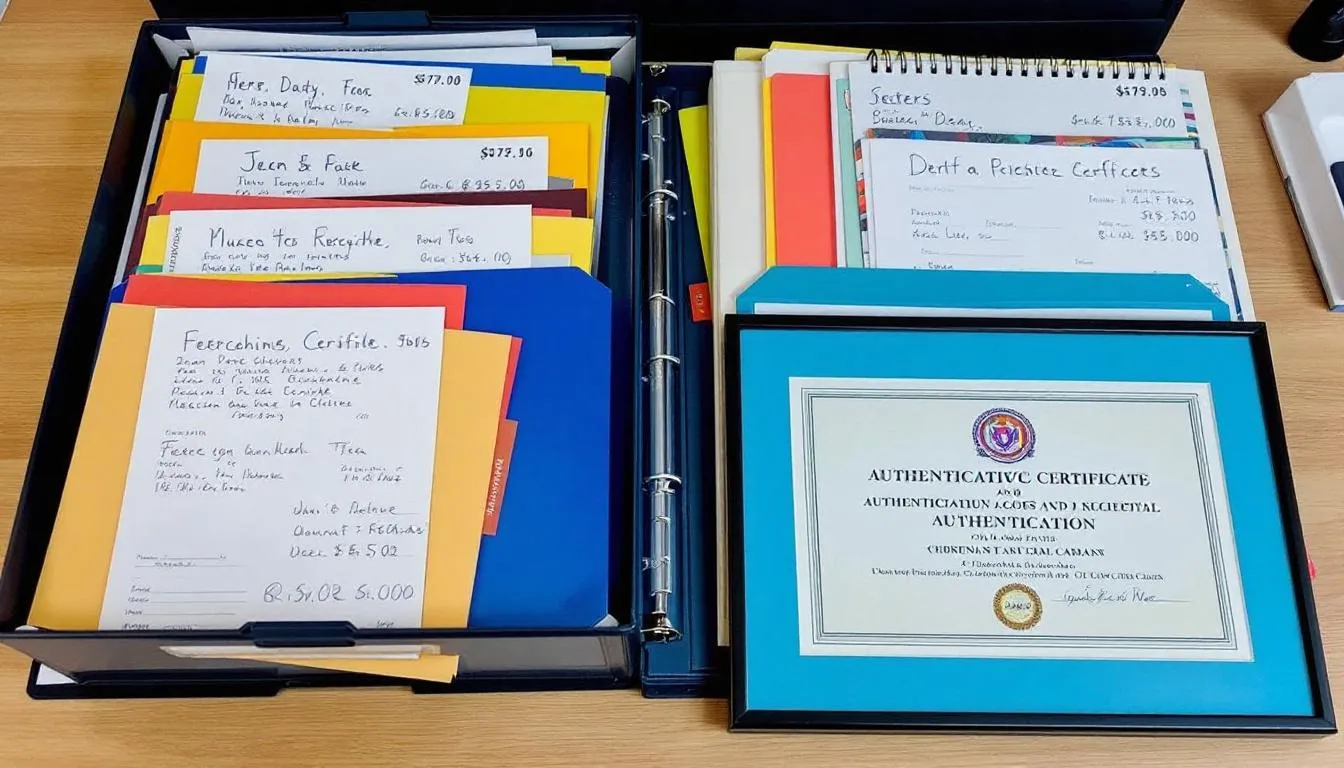
Critical documentation includes:
Purchase Records: Original receipts, invoices, or other proof of purchase establishing your cost basis. For inherited items, estate documentation showing the stepped-up basis is crucial.
Authentication and Grading: Professional grading reports from PSA, BGS, or other recognized services not only protect your investment but also provide official documentation of condition and authenticity.
Digital Documentation: Timestamped photos showing the condition of items over time can support valuations and help resolve disputes about fair market value.
Professional Appraisals: For high-value items, regular appraisals provide evidence of current market values and can support insurance claims or charitable donation deductions.
Transaction Logs: Detailed records of all buying and selling activities, including dates, counterparties, and terms of sale. This becomes particularly important for active traders who may complete dozens of transactions annually.
Modern technology has made record-keeping easier through specialized software and apps designed for collectors. Many successful collectors maintain digital databases with photos, purchase information, and current market values for their entire collection.
The quality of your documentation can significantly impact your tax liability. Poor record-keeping may result in the IRS disallowing claimed basis or applying higher tax rates due to inability to prove holding periods.
State Tax Considerations and Compliance
State tax obligations add another layer of complexity for collectible owners, particularly those who buy and sell across state lines. Each state has its own rules regarding capital gains taxation, sales tax obligations, and compliance requirements. Collectors must address state tax obligations by understanding and following the specific rules and procedures in each relevant jurisdiction.
State Capital Gains Rates: States like California and New York impose significant state income taxes on capital gains, while states like Texas and Florida have no state income tax. A collectible sale that generates $10,000 in federal tax liability could result in an additional $1,000-$1,300 in state taxes depending on your location.
Sales Tax Obligations: Collectors who regularly sell items may be required to collect and remit sales tax, particularly if they’re classified as dealers. This requirement varies by state and can apply to online sales as well as in-person transactions.
Multi-State Compliance: Online sellers often face nexus issues when selling to buyers in multiple states. The complexity of tracking and complying with various state requirements has increased significantly following the Supreme Court’s decision in South Dakota v. Wayfair.
Use Tax Requirements: Collectors who purchase items from out-of-state dealers may owe use tax in their home state if sales tax wasn’t collected at the time of purchase.
The rise of online marketplaces has made state tax compliance more challenging, as platforms may or may not handle sales tax collection automatically. Collectors who sell regularly should consult with tax professionals familiar with multi-state commerce requirements.
Some states offer specific exemptions or reduced rates for certain types of collectibles, particularly items with historical or cultural significance. Understanding these provisions can result in meaningful tax savings for collectors in affected states.
FAQ
Do I need to pay taxes on collectibles I’ve held for over 30 years?
Yes, when you sell collectibles held for any length of time, you’re subject to capital gains tax. However, collectibles held for over one year qualify for long-term capital gains treatment, capped at 28% rather than ordinary income rates. The length of time you’ve held the item doesn’t reduce the tax rate further, but it does ensure you qualify for the more favorable long-term treatment rather than short-term rates that can reach 37%.
Can I use losses from selling collectibles to offset other investment gains?
Yes, capital losses from collectible sales can offset capital gains from any source, including stocks and bonds. If your total capital losses exceed your capital gains for the year, you can deduct up to $3,000 annually against ordinary income. Any remaining losses carry forward to future tax years indefinitely, maintaining their character as capital losses.
What happens if I can’t prove the original purchase price of inherited collectibles?
Without documentation of the original purchase price, you may still benefit from the stepped-up basis rule if the collectibles were inherited. The stepped-up basis equals the fair market value at the time of inheritance, regardless of what the deceased originally paid. However, you’ll need professional appraisals to establish this value, and you may need to research comparable sales from around the inheritance date to support your position.
Are grading fees and authentication costs deductible when calculating capital gains?
Yes, costs directly related to improving or maintaining collectibles can typically be added to your cost basis, reducing taxable gains when sold. This includes professional grading fees from services like PSA or BGS, authentication services, conservation work, and storage costs. However, regular maintenance and insurance costs are generally not eligible for basis adjustment.
How does the IRS determine if I’m a collectible dealer versus an investor?
The IRS considers multiple factors including frequency of sales, time spent on collectible activities, dependence on collectible income, and expertise in the field. Regular buying and selling with profit intent typically indicates dealer status, subjecting profits to self-employment tax in addition to income tax. However, dealer status also allows deduction of business expenses that investors cannot claim. The determination is made based on all facts and circumstances of your particular situation.
What are some common phrases used in tax discussions about collectibles?
Common phrases include "how so" and "how come," which are often used to ask for clarification about tax rules or reasons for certain tax treatments. These phrases help facilitate discussion and understanding in conversations about collectible taxes.
What are the different hows of handling collectible taxes?
There are several hows, or methods, for managing collectible taxes, such as keeping detailed records, understanding cost basis adjustments, and consulting with tax professionals. Each approach can affect your tax outcome, so it's important to choose the method that best fits your situation.
Do I need to pay attention to the title of documents or records for my collectibles?
Yes, the title or naming convention of your documents and records is important for tax purposes. Properly titled receipts, appraisals, and ownership documents help establish provenance and support your tax filings if questioned by the IRS.
Should I visit a tax professional for advice on collectible taxes?
Yes, it is a good idea to visit a tax professional if you have questions or complex situations regarding collectible taxes. A professional can provide personalized advice and help ensure you comply with IRS rules.
How are collectibles related to presidents treated for tax purposes?
If you own collectibles related to a president, such as signed documents or memorabilia, they are generally treated the same as other collectibles for tax purposes. The fact that the item is associated with a president does not change its tax treatment, but its value and documentation may be especially important.
Disclosures
Securities and investment advisory services offered through Integrity Alliance, LLC, Member SIPC www.sipc.org (opens in a new window). Integrity Wealth is a marketing name for Integrity Alliance, LLC. Revolutionary Wealth LLC is not affiliated with Integrity Wealth. This site is published for residents of the United States only. Representatives may only conduct business with residents of the states and jurisdictions in which they are properly registered. Therefore, a response to a request for information may be delayed until appropriate registration is obtained or exemption from registration is determined. Not all services referenced on this site are available in every state and through every advisor listed. Tax and legal services are not offered through Integrity Wealth.
Full disclosures
Neither Asset Allocation nor Diversification guarantee a profit or protect against a loss in a declining market. They are methods used to help manage investment risk.
Active portfolio management, including market timing, can subject longer term investors to potentially higher fees and can have a negative effect on the long-term performance due to the transaction costs of the short-term trading. In addition, there may be potential tax consequences from these strategies. Active portfolio management and market timing may be unsuitable for some investors depending on their specific investment objectives and financial position. Active portfolio management does not guarantee a profit or protect against a loss in a declining market.
Rebalancing/Reallocating can entail transaction costs and tax consequences that should be considered when determining a rebalancing/reallocation strategy.
Tax-loss harvesting is a strategy of selling securities at a loss to offset a capital gains tax liability. It is typically used to limit the recognition of short-term capital gains, which are normally taxed at higher federal income tax rates than long-term capital gains, though it is also used for long-term capital gains.
Not associated with or endorsed by the Social Security Administration, Medicare or any other government agency. Maximizing your Social Security Benefits assumes foreknowledge of your date of death. If as an example you wait to claim a higher monthly benefit amount but predecease your average life expectancy, it would have been better to claim your benefits at an earlier age with reduced benefits.
Any references to protection or steady and reliable income streams refer only to fixed insurance products. References to protection can also refer to estate planning. They do not refer, in any way, to securities or investment advisory products.
Fixed Annuities are long term insurance contracts and there is a surrender charge imposed generally during the first 5 to 7 years that you own the annuity contract. Withdrawals prior to age 59 1/2 may result in a 10% IRS tax penalty, in addition to any ordinary income tax. Any guarantees of the annuity are backed by the financial strength of the underlying insurance company.
Mutual Funds are sold by prospectus. Please consider the investment objectives, risks, charges, and expenses carefully before investing in Mutual Funds. The prospectus, which contains this and other information about the investment company, can be obtained directly from the Fund Company or your financial professional. Be sure to read the prospectus carefully before deciding whether to invest. An investment in the Fund involves risk, including possible loss of principal.
A REIT is a security that sells like a stock on the major exchanges and invests in real estate directly, either through properties or mortgages. REITs receive special tax considerations and typically offer investors high yields, as well as a highly liquid method of investing in real estate. There are risks associated with these types of investments and include but are not limited to the following: Typically no secondary market exists for the security listed above. Potential difficulty discerning between routine interest payments and principal repayment. Redemption price of a REIT may be worth more or less than the original price paid. Value of the shares in the trust will fluctuate with the portfolio of underlying real estate. Involves risks such as refinancing in the real estate industry, interest rates, availability of mortgage funds, operating expenses, cost of insurance, lease terminations, potential economic and regulatory changes. This is neither an offer to sell nor a solicitation or an offer to buy the securities described herein. The offering is made only by the Prospectus.
Converting an employer plan account or Traditional IRA to a Roth IRA is a taxable event. Increased taxable income from the Roth IRA conversion may have several consequences including but not limited to, a need for additional tax withholding or estimated tax payments, the loss of certain tax deductions and credits, and higher taxes on Social Security benefits and higher Medicare premiums. Be sure to consult with a qualified tax advisor before making any decisions regarding your IRA.
Indexed annuities are insurance contracts that, depending on the contract, may offer a guaranteed annual interest rate and some participation growth, if any, of a stock market index. Such contracts have substantial variation in terms, costs of guarantees and features and may cap participation or returns in significant ways. Any guarantees offered are backed by the financial strength of the insurance company. Surrender charges apply if not held to the end of the term. Withdrawals are taxed as ordinary income and, if taken prior to 59 1/2, a 10% federal tax penalty. Investors are cautioned to carefully review an indexed annuity for its features, costs, risks, and how the variables are calculated.
Please consider the investment objectives, risks, charges, and expenses carefully before investing in Variable Annuities. The prospectus, which contains this and other information about the variable annuity contract and the underlying investment options, can be obtained from the insurance company or your financial professional. Be sure to read the prospectus carefully before deciding whether to invest.
The investment return and principal value of the variable annuity investment options are not guaranteed. Variable annuity sub-accounts fluctuate with changes in market conditions. The principal may be worth more or less than the original amount invested when the annuity is surrendered.
QLACs cannot be purchased with Roth or Inherited IRA dollars; value of such IRAs cannot be included in determining 25% premium limit. If Funding Source is Traditional IRA, 25% limit is calculated by combining the total value of all Traditional IRAs as of December 31st of the previous year. If Funding source is Employer sponsored qualified plan (401k, 403b and governmental 457b), 25% limit is calculated on an individual plan basis based on the plan's account value on the previous day's market close. If you previously purchased a QLAC, the calculation of your 25% limit is more complicated. Please contact an attorney or tax professional for additional details. Any guarantees of the annuity are backed by the financial strength of the underlying insurance company.
The projections or other information generated by Monte Carlo analysis tools regarding the likelihood of various investment outcomes are hypothetical in nature, are based on assumptions that you provide which could prove to be inaccurate over time, do not reflect actual investment results, and are not guarantees of future results. Results may vary with each use and over time.
This material is for general informational purposes only and is not intended to provide specific investment, tax, or legal advice or recommendations for any individual. Consult with your own tax or legal professional regarding your specific situation before acting on any information presented here. The information has been developed from sources believed to be providing accurate information, but no representation is made as to its accuracy or completeness.
Cash balance and other qualified retirement plan strategies described here are general in nature; actual contribution limits, deductibility, and plan design depend on individual circumstances, plan documents, and applicable IRS rules, and should be reviewed with a qualified plan actuary or administrator.