

Value of Sports Cards: How to Figure Out What Your Collection Is Really Worth
Key Takeaways
- 01Card value depends primarily on the player, card type (rookie, parallel, autograph, patch), condition, and whether it’s been graded by PSA, Beckett, or SGC. A graded gem mint copy of a star rookie can be worth 10x or more than the same card in raw, ungraded form.
- 02You can quickly estimate value by looking up recent sold listings on eBay, using pricing tools like Market Movers, Sports Card Investor, and Card Ladder, and comparing raw versus graded prices for the same specific cards.
- 03Grading can dramatically increase value on high-end cards but often isn’t worth it for low-value base cards. Modern parallels and numbered cards tend to hold more value than mass-produced base versions, so focus your grading budget on cards that already sell for at least $75-$100 raw.
- 04Regular buying and selling of sports cards may be taxable in the U.S. and other countries. Collectors should track purchase prices, sale prices, and fees for accurate tax reporting and consult a tax professional for guidance.
- 05This article walks you step-by-step through identifying valuable card types, choosing grading options, using valuation software, and understanding basic tax implications so you can confidently assess what your collection is really worth.
What Makes a Sports Card Valuable?
Even two cards of the same player can differ hugely in value depending on specific factors. A 2018 Luka Dončić Prizm Silver PSA 10 can be worth several hundred dollars, while a base Hoops rookie of the same player might only fetch a few dollars. Understanding what separates a valuable card from a common one is the foundation of building—or selling—a meaningful card collection.
The main value drivers for trading cards include:
Factor | Description | Example |
|---|---|---|
Player Popularity | Hall of Famers, MVPs, and rising stars command premiums | Michael Jordan, LeBron James, Shohei Ohtani, Patrick Mahomes, Lionel Messi |
Card Type | Rookie cards, inserts, parallels, autographs, and relics vary in desirability | True rookie vs. second-year card |
Scarcity | Serial numbering (/10, /25, /99), short prints (SP), and super short prints (SSP) | Gold Prizm /10 vs. base card |
Brand and Set | Premium brands carry more weight | Topps Chrome, Panini Prizm, National Treasures, Flawless, Bowman Chrome 1st |
Condition | Corners, edges, centering, and surface all affect grade potential | PSA 10 vs. PSA 7 |
Pre-1980 “vintage” cards like the 1952 Topps Mickey Mantle, 1961 Fleer Wilt Chamberlain, or 1969 Topps Lew Alcindor often derive their value from historical significance and rarity. Lower print runs and decades of handling mean fewer examples survived in top condition, making high-grade vintage exceptionally valuable.
The “junk wax era” (roughly 1987–1994) presents a different story. Mass production during this period means most cards have minimal value unless they feature star rookies in top condition or rare inserts. Notable exceptions include the 1986-87 Fleer Michael Jordan, 1993 SP Derek Jeter, and 1990s Precious Metal Gems inserts.
To illustrate how scarcity affects prices, consider this comparison:
2020 Panini Prizm Justin Herbert Base Rookie:$5-$15 raw
2020 Panini Prizm Justin Herbert Red /149:$150-$300+ raw
That’s a 20x to 30x difference for the same player, same year, simply because the parallel is numbered and scarce.
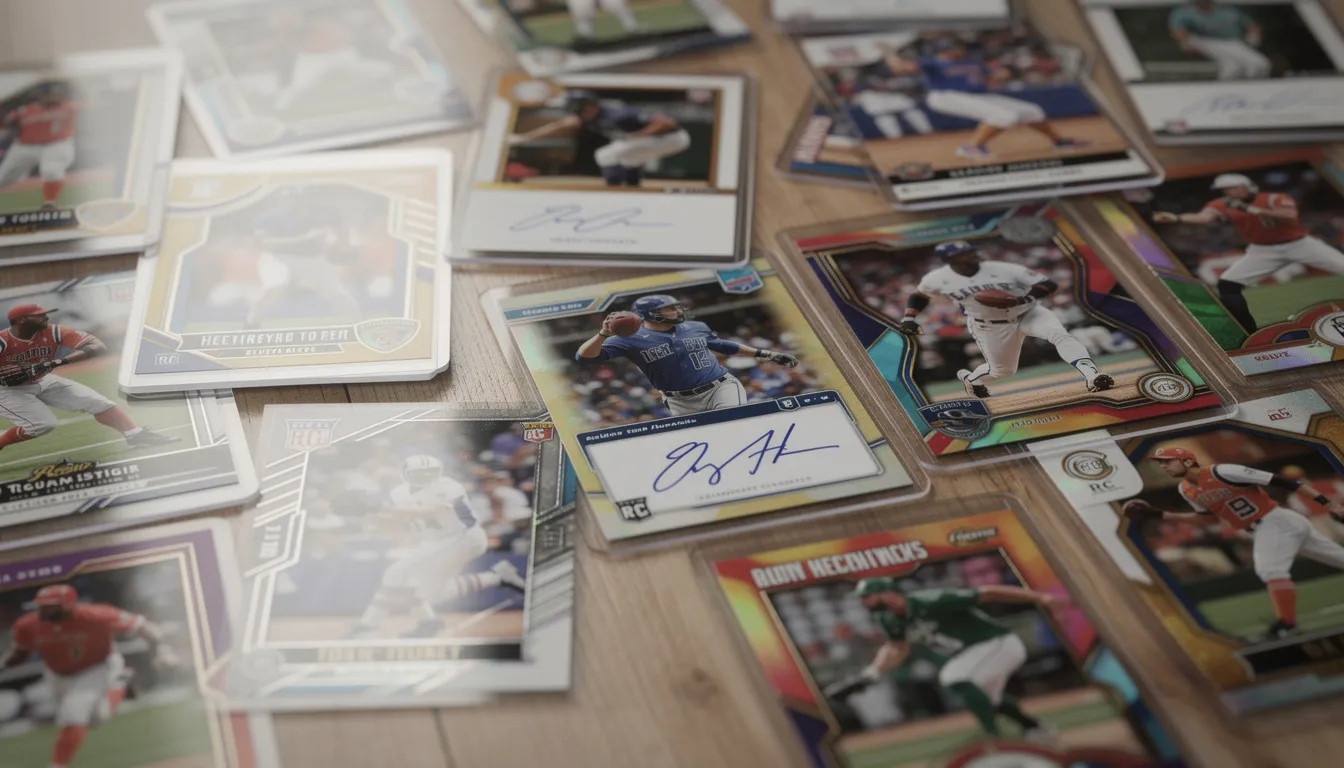
Types of Sports Cards That Tend to Hold the Most Value
This section breaks down the main card types you should look for when evaluating your own collection. Knowing what to search for can help you instantly recognize cards worth researching further versus those destined for the commons box.
Rookie Cards
A “true rookie” is the first major licensed card of a player, issued during their first professional season. These are the cornerstone of any valuable collection because they represent the earliest official cardboard representation of that athlete.
High-value rookie card examples include:
2003-04 Topps Chrome LeBron James
2011 Topps Update Mike Trout
2017 Panini Prizm Patrick Mahomes
2019 Panini Prizm Zion Williamson
Research shows that rookie cards represent both the largest segment and the fastest-growing category in the sports trading card market, with long-term value appreciation serving as a significant motivation for other collectors.
Earlier “pre-rookie” or prospect cards—particularly Bowman Chrome 1st editions for baseball—can also be extremely valuable for players who become stars.
Parallels and Refractors
Parallels are variations of the base card featuring different colors, finishes, or serial numbering. The hierarchy typically looks like this:
Base card: Unlimited print run, lowest value
Silver Prizm/Refractor: More desirable, moderate premium
Numbered colors (Blue /199, Gold /10, Green /5): Significant value increase
Special finishes (Cracked Ice, Mojo, Sapphire): Highly sought after
For example, a 2018 Panini Prizm Luka Dončić Silver Prizm typically sells for multiples of the base card—sometimes 5x to 10x more in comparable condition.
Autographs and Relics
Autographed cards and those containing game-worn or player-worn memorabilia (patches, jerseys) add another layer of collectibility:
On-card autos: Player signed directly on the card (more valuable)
Sticker autos: Signature on a sticker applied to the card (less valuable)
Rookie Patch Autos (RPAs): Combine first-year cards with autograph and patch—considered the pinnacle for many modern collectors
Star and Hall of Fame autographs retain value far better than those of role players. A National Treasures RPA of a franchise quarterback can be worth thousands, while a backup’s might struggle to sell.
Short Prints and Case Hits
Short prints (SP), super short prints (SSP), and case hits fall less frequently in hobby boxes and often maintain long-term demand:
Downtown: Highly sought-after artistic insert
Kaboom!: Colorful pop-art style insert
Color Blast: Rare chromium insert
Topps Home Field Advantage: Baseball-specific short print
Base cards and unnumbered inserts from ultra-modern years (2018–present) are usually less desirable unless they feature top-tier players or belong to recognized “chase” insert sets.
Raw vs Graded Cards: How Condition Affects Value
The largest jumps in card value often come from getting high grades from trusted companies like PSA, BGS (Beckett Grading Services), and SGC. A raw card that looks mint to the naked eye might sell for $50, while the same card in a PSA 10 slab could fetch $200 or more.
Raw cards are ungraded, stored in penny sleeves or top loaders.Slabbed cards are professionally encased with a grade displayed on the label. Buyers pay a premium for third-party assurance of authenticity and condition—it removes guesswork from the transaction.
Understanding the Grading Scale
Most grading companies use a 1-10 scale:
Grade | Description | Value Impact |
|---|---|---|
10 (Gem Mint) | Perfect or near-perfect | Maximum premium |
9 (Mint) | Minor imperfection | Strong value |
8 (NM-MT) | Light wear visible | Moderate value |
7 and below | Noticeable flaws | Significant discount |
Research indicates that high-graded cards yield significantly higher returns than lower-graded counterparts in the marketplace.
Condition Checks You Can Do at Home
Before submitting cards for grading, examine them under good lighting with a magnifying glass:
Corners: Should be sharp with no dings or fraying
Edges: Check for chipping or whitening
Centering: Compare border widths on front and back
Surface: Look for scratches, print lines, or fingerprints
Here’s a real-world pricing example showing why condition matters:
2019 Topps Chrome Fernando Tatis Jr. Raw:$15-$30
2019 Topps Chrome Fernando Tatis Jr. PSA 9:$40-$60
2019 Topps Chrome Fernando Tatis Jr. PSA 10:$150-$250
That’s a potential 8x to 10x increase from raw to PSA 10—if your card grades at the top of the scale.
Important note: Vintage cards (pre-1970) can still be valuable at lower grades because of their scarcity, while ultra-modern cards typically need a 9 or 10 to justify grading costs.
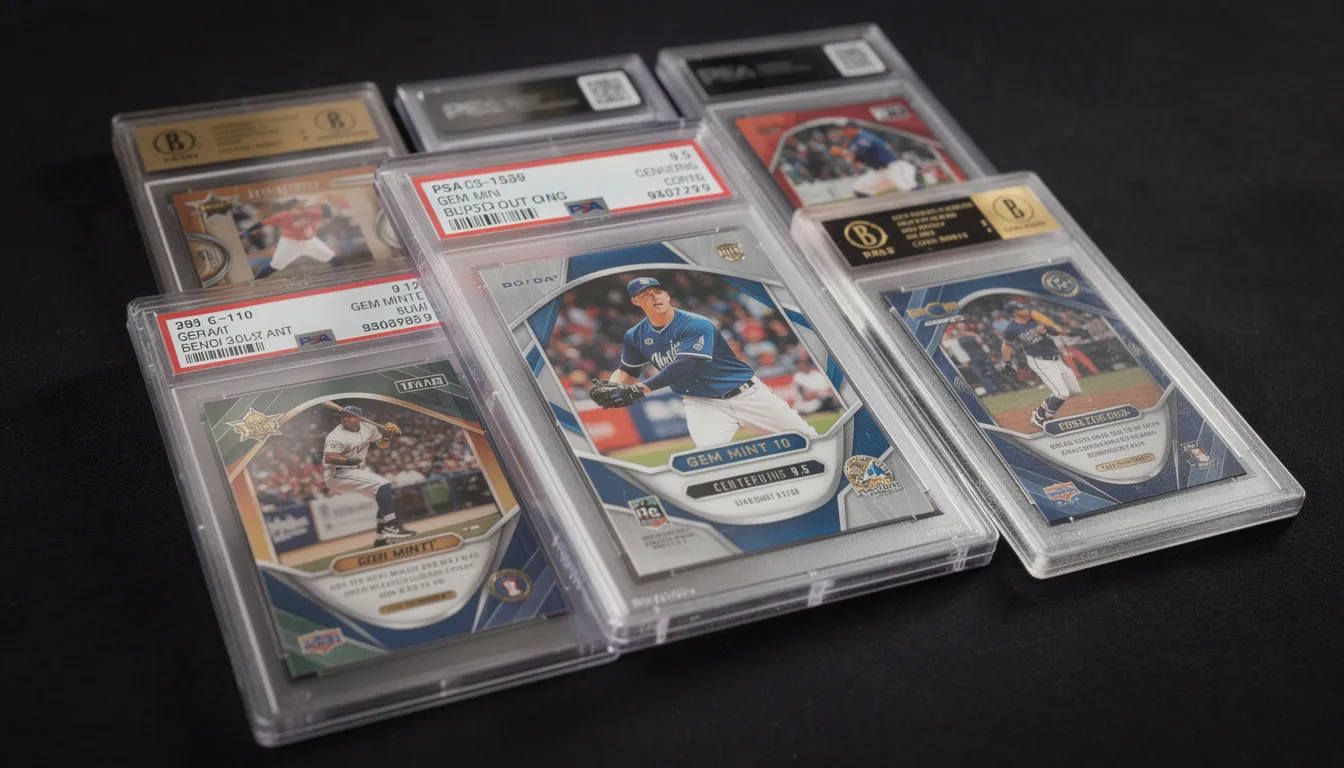
Choosing a Grading Company (PSA, BGS, SGC, Others)
Each grading company has different turnaround times, fees, aesthetics, and resale values. The choice can meaningfully impact how much your card will sell for on the secondary market.
PSA (Professional Sports Authenticator)
PSA is the current market leader for resale value on most modern sports cards. A PSA 10 is often viewed as the “gold standard” and typically commands the highest prices among grading services. Their slabs are recognizable, and the database of graded cards is extensive.
Best for: Modern cards, maximizing resale value, most sports
BGS (Beckett Grading Services)
Beckett is known for subgrades that break down condition into four categories: centering, corners, edges, and surface. The BGS 9.5 “Gem Mint” and BGS 10 “Black Label” are highly respected.
Best for: Collectors who value detailed condition analysis, certain high-end chrome and patch cards from 2005-2015
SGC (Sportscard Guaranty Company)
SGC has earned respect especially for vintage cards (pre-war baseball, 1950s Topps) and is increasingly accepted for modern submissions. They offer competitive pricing and often faster turnaround times. The distinctive black insert provides a sleek look.
Best for: Vintage cards, budget-conscious grading, faster service
Other Options
Companies like CGC and TAG exist but have less established markets. Before choosing them for high-value cards, check recent sold prices to ensure buyers will pay comparable amounts.
When Grading Makes Sense
Consider grading when:
The card already sells raw for at least $75-$100
It features a key rookie of a star player
It’s a scarce numbered parallel with strong demand
It’s a vintage star in apparently high-grade condition
Avoid grading low-value base cards from mass-produced modern sets. If grading fees plus shipping exceed $30-$50 and your card likely won’t sell for more than that graded, you’re losing money.
How to Estimate the Value of Your Sports Cards Step-by-Step
This is the core how-to section. Follow this process the same day to start pricing your collection accurately. When valuing your sports cards, it's important to check the date of recent sales to understand both current and historical card values.
You can quickly calculate the total value of multiple sports cards using a lot value calculator.
Additionally, you can access a sports card price guide that features millions of cards and sales charts to help with accurate valuation.
Step 1: Identify the Card Exactly
You need to know: sport, year, brand, set, player, card number, and any parallel designation. For example:
2020 Panini Prizm Football #325 Justin Herbert Silver Prizm
Not just “Herbert rookie.”
Find this information by:
Checking the card front for brand logo and set name
Looking at the card back for year, card number, and set details
Noting any special colors, numbering, or “Prizm,” “Refractor,” or “Parallel” text
Step 2: Look Up Recent Sold Listings
Go to eBay and search for your exact card. Then:
Filter by “Sold Items” under “Show only”
Match the condition (raw vs. graded, specific grade)
Ignore outlier asking prices—only trust actual sales
Be sure to check the date of each sale to ensure you are using the most recent and relevant data. eBay Deal Scanner shows sports card deals on eBay seconds after being listed for sale, helping you access up-to-date market information.
A cluster of recent sales is more reliable than one data point. If five copies sold for $45-$55 in the last month, that’s your market price.
Other marketplaces like COMC, MySlabs, and auction house archives can supplement your research.
Step 3: Adjust for Condition
Compare your card’s centering, edges, corners, and surface to photos of raw and graded cards that sold. If your card has a visible corner ding, it’s not comparable to a PSA 10 sale. Mentally adjust your expected value based on realistic condition assessment.
Step 4: Consider Supply and Demand
Check how many of the same card are currently listed. If dozens are available, oversupply may depress prices. If very few exist for sale, you might command a premium.
Also consider timing: playoffs, Hall of Fame inductions, championships, trades, and injuries can all temporarily spike or drop values for specific players.
Step 5: Decide Whether to Grade, Hold, or Sell Raw
Calculate your rough after-fee profit before sending a card for grading:
- Item:Expected graded sale priceExample Cost:$200
- Item:Minus grading feeExample Cost:-$35
- Item:Minus shipping (both ways)Example Cost:-$15
- Item:Minus marketplace fees (13%)Example Cost:-$26
- Item:Net proceedsExample Cost:$124
If you could sell the card raw for $100, grading only nets you an extra $24—and that’s if it gets a 10. Factor in the risk of a lower grade and decide accordingly.
Using Valuation Software: Market Movers, Sports Card Investor, and Card Ladder
Modern pricing tools can save time and provide charts, averages, and trends across multiple marketplaces. For the fastest and most efficient experience, download a sports card scanner app to access features like instant card recognition, price estimation, and digital collection management. These apps are fast, allowing you to quickly recognize and appraise cards, saving you valuable time during the identification and valuation process. You can also organize your entire collection with digital collection management tools, making it easier to keep track of your cards and their values. This is especially helpful for anyone with more than a handful of valuable cards to track.
Market Movers
Market Movers is a paid tool by Sports Card Investor that aggregates sales from eBay and other marketplaces. It’s designed for quick and easy sales history data access.
Key features include:
Searchable database across major sports and sets
Price charts over time (7-day, 30-day, 1-year views)
Portfolio tracking for your entire collection
Alerts for price movements on cards you’re watching
You can track specific cards like a 2023 Topps Chrome Elly De La Cruz rookie across multiple grades and see real time prices in a unified interface.
Sports Card Investor
The Sports Card Investor website and app offer both free and paid tiers. Features include:
Quick price look-ups
Basic card value calculator
Trending cards lists highlighting big percentage movers
Educational content on market trends
This is a solid starting point for collectors who want to check values without a major subscription commitment.
Card Ladder
Card Ladder focuses on verified sales data and historical price charts. Their “Ladder” index tracks market segments over time, similar to stock market indices.
Use Card Ladder to:
Find the long-term trend of classic cards like a 1986 Fleer Michael Jordan PSA 8
Track modern Prizm Silver rookies across multiple years
Access a comprehensive database of authenticated sales
How to Use These Tools in Practice
Cross-check your eBay research: Compare your manual findings with the software’s average or “last sold” price
Study multiple timeframes: Look at 7-day vs. 30-day vs. 1-year charts to avoid overreacting to short spikes
Use portfolio features: Track your total collection value over time like a stock portfolio
Set alerts: Get notified when cards you’re holding hit target prices
Image Recognition Apps
Apps like CollX let you scan and snap a photo to quickly identify many mainstream cards. This can save time for organizing large collections. However, always verify values using sold data and established tools like Market Movers, Sports Card Investor, or Card Ladder before making buy or sell decisions.

Tax Implications of Buying and Selling Sports Cards
Disclaimer: This section is educational, not formal tax advice. Consult a certified tax professional in your country for guidance specific to your situation. The examples below use U.S. rules as of recent years for context.
How Card Profits Are Taxed
In the United States, profits from selling sports cards are generally treated as capital gains—or sometimes as hobby or business income—depending on the scale and intent. The distinction matters:
Long-term holdings (over one year): May qualify for lower capital gains rates
Short-term flips (under one year): Taxed as ordinary income at your marginal rate
Collectibles rate: The IRS may apply a maximum 28% rate to collectibles gains
Understanding Cost Basis
Your cost basis is what you paid for the card plus associated costs:
Original purchase price
Shipping costs to acquire the card
Grading fees
Selling platform fees
When you sell, your taxable gain equals sale price minus cost basis. Keep records including:
Receipts and invoices
Screenshots of original purchases
Grading submission confirmations
Spreadsheets tracking acquisition dates and costs
Marketplace Reporting Requirements
Online marketplaces and payment processors like eBay, PayPal, Venmo, and Stripe may issue tax forms (Form 1099-K in the U.S.) once you exceed certain thresholds in total payment volume or number of transactions. These forms are reported to tax authorities, so maintaining accurate records is essential.
Hobby vs. Business Seller
Aspect | Casual Hobbyist | Business Seller |
|---|---|---|
Selling frequency | Occasional | Regular/frequent |
Expense deductions | Limited | Supplies, shipping, software subscriptions, show travel |
Reporting complexity | Simpler | Schedule C, possible self-employment taxes |
Intent | Personal enjoyment | Profit motive |
If you actively trade cards for profit, you may want to consult with a tax professional about whether operating as a business makes sense for your situation.
International Considerations
Many countries treat card profits as taxable gains with varying thresholds and rules. Research your local laws or consult a local advisor. Regardless of location, track all card-related income and expenses annually in a simple spreadsheet or dedicated app—it makes tax season far less stressful.
Common Mistakes When Valuing Sports Cards
This section helps beginners avoid typical errors that can cause them to overpay when buying or undersell when liquidating their collection.
Using Asking Prices Instead of Sold Prices
Many listings sit unsold at unrealistic numbers for months or years. Never use asking prices to judge real market value. Always filter for “Sold Items” on eBay or use pricing tools that track actual completed transactions.
Ignoring Condition
A creased, off-centered, or surface-damaged card can be worth a fraction of a clean example. Before valuing any card, examine it closely under good lighting. That “mint” card you remember from childhood may have developed issues from improper storage over the decades.
Assuming All Older Cards Are Valuable
The junk wax era (1987-1994) produced billions of cards. Most have minimal value except for:
Top stars in high grade (PSA 9/10)
Rare inserts
Recognized key rookies
Don’t assume age equals value. The 1990 Donruss commons box in your closet is probably worth less than the shipping cost to send it anywhere.
Grading Everything
Many collectors lose money sending low-end base or “bulk” rookies to grading when fees plus shipping exceed any potential value increase. Calculate the math before submitting. If your card sells raw for $20 and might fetch $40 graded, you’re likely breaking even at best after all costs.
Emotional Bias
It’s natural to love certain cards because of personal memories or favorite players. But the market doesn’t care about your sentimental attachment. Rely on real market data from eBay solds and pricing tools rather than what you wish your cards were worth.
Don’t overpay for cards in your portfolio just because you’re excited, and don’t refuse fair offers because you’re emotionally attached to a card’s asking price you dreamed up.
FAQ
How do I know if a card is worth grading with PSA, BGS, or SGC?
First, check recent sold prices for the same card both raw and graded (PSA 9/10, BGS 9.5, SGC 9/10) on eBay or through pricing tools. Calculate whether the graded sale price minus grading fees, shipping, and expected taxes still leaves a meaningful profit. Then examine your card under magnification—if you see corner dings, centering issues, or surface scratches, it likely won’t achieve the high grade needed to justify the cost. Grading generally makes sense when raw value exceeds $75-$100 and condition appears excellent.
Are digital and NFT sports cards valued the same way as physical cards?
Digital and NFT-based assets follow different marketplaces, liquidity patterns, and regulations than physical trading cards. Their value depends on platform popularity, programmed scarcity, and collector demand within those ecosystems. While some notable sports NFT sales have reached millions of dollars, they don’t have the same long-term track record as traditional cardboard. This article focuses primarily on physical cards, which remain the dominant segment in terms of market revenue.
Can I use insurance to protect the value of my sports card collection?
Yes, significant collections can often be insured either through a rider on a homeowner’s or renter’s policy or with specialty collectibles insurers. Get a written inventory with approximate current values using tools like Market Movers, Card Ladder, or professional appraisals. Keep photos of key cards, grading labels, and storage conditions to support any future claims. Review your policy limits and coverage terms carefully—some standard policies have low caps on collectibles.
How often should I re-check the value of my cards?
Casual collectors should review values at least once or twice a year. Active buyers and sellers benefit from monthly checks or monitoring around key events like playoffs, championships, Hall of Fame inductions, major trades, or injuries. Modern ultra-active players can swing in value quickly based on performance, while vintage legends typically move more slowly and steadily.
Where can I safely sell my cards once I know their value?
Major platforms include eBay (largest audience, 13% fees), COMC (consignment model, good for lower-value cards), PWCC (auction house for higher-end cards), MySlabs (newer marketplace focused on graded cards), and reputable local card stores or shows. Check selling fees, shipping policies, and buyer protections on each platform. Factor these costs into your net proceeds and potential tax obligations when deciding where to list your cards for sale.
Want more tips and updates about the value of sports cards? Sign up for our newsletter to receive exclusive content and stay informed.
Disclosures
This blog contains general information that may not be suitable for everyone. The information contained herein should not be construed as personalized investment advice. There is no guarantee that the views and opinions expressed in this blog will come to pass. Investing in the stock market involves gains and losses and may not be suitable for all investors. Information presented herein is subject to change without notice and should not be considered as a solicitation to buy or sell any security. Revolutionary Wealth LLC does not offer legal or tax advice. Please consult the appropriate professional regarding your individual circumstance. Past performance is no guarantee of future results.
Mutual Funds are sold by prospectus. Please consider the investment objectives, risks, charges, and expenses carefully before investing in Mutual Funds. The prospectus, which contains this and other information about the investment company, can be obtained directly from the Fund Company or your financial professional. Be sure to read the prospectus carefully before deciding whether to invest. An investment in the Fund involves risk, including possible loss of principal.
Rebalancing/Reallocating can entail transaction costs and tax consequences that should be considered when determining a rebalancing/reallocation strategy.
A REIT is a security that sells like a stock on the major exchanges and invests in real estate directly, either through properties or mortgages. REITs receive special tax considerations and typically offer investors high yields, as well as a highly liquid method of investing in real estate. There are risks associated with these types of investments and include but are not limited to the following: Typically no secondary market exists for the security listed above. Potential difficulty discerning between routine interest payments and principal repayment. Redemption price of a REIT may be worth more or less than the original price paid. Value of the shares in the trust will fluctuate with the portfolio of underlying real estate. Involves risks such as refinancing in the real estate industry, interest rates, availability of mortgage funds, operating expenses, cost of insurance, lease terminations, potential economic and regulatory changes. This is neither an offer to sell nor a solicitation or an offer to buy the securities described herein. The offering is made only by the Prospectus.
Diversification does not guarantee a profit or protect against a loss in a declining market. It is a method used to help manage investment risk.
Converting an employer plan account or Traditional IRA to a Roth IRA is a taxable event. Increased taxable income from the Roth IRA conversion may have several consequences including but not limited to, a need for additional tax withholding or estimated tax payments, the loss of certain tax deductions and credits, and higher taxes on Social Security benefits and higher Medicare premiums. Be sure to consult with a qualified tax advisor before making any decisions regarding your IRA.
Indexed annuities are insurance contracts that, depending on the contract, may offer a guaranteed annual interest rate and some participation growth, if any, of a stock market index. Such contracts have substantial variation in terms, costs of guarantees and features and may cap participation or returns in significant ways. Any guarantees offered are backed by the financial strength of the insurance company. Surrender charges apply if not held to the end of the term. Withdrawals are taxed as ordinary income and, if taken prior to 59 ½, a 10% federal tax penalty. Investors are cautioned to carefully review an indexed annuity for its features, costs, risks, and how the variables are calculated.
Not associated with or endorsed by the Social Security Administration, Medicare or any other government agency. Maximizing your Social Security Benefits assumes foreknowledge of your date of death. If as an example you wait to claim a higher monthly benefit amount but predecease your average life expectancy, it would have been better to claim your benefits at an earlier age with reduced benefits.
Please consider the investment objectives, risks, charges, and expenses carefully before investing in Variable Annuities. The prospectus, which contains this and other information about the variable annuity contract and the underlying investment options, can be obtained from the insurance company or your financial professional. Be sure to read the prospectus carefully before deciding whether to invest.
The investment return and principal value of the variable annuity investment options are not guaranteed. Variable annuity sub-accounts fluctuate with changes in market conditions. The principal may be worth more or less than the original amount invested when the annuity is surrendered.
QLACs cannot be purchased with Roth or Inherited IRA dollars; value of such IRAs cannot be included in determining 25% premium limit. If Funding Source is Traditional IRA, 25% limit is calculated by combining the total value of all Traditional IRAs as of December 31st of the previous year. If Funding source is Employer sponsored qualified plan (401k, 403b and governmental 457b), 25% limit is calculated on an individual plan basis based on the plan’s account value on the previous day’s market close. If you previously purchased a QLAC, the calculation of your 25% limit is more complicated. Please contact an attorney or tax professional for additional details. Any guarantees of the annuity are backed by the financial strength of the underlying insurance company.
The projections or other information generated by Monte Carlo analysis tools regarding the likelihood of various investment outcomes are hypothetical in nature, are based on assumptions that you provide which could prove to be inaccurate over time, do not reflect actual investment results, and are not guarantees of future results. Results may vary with each use and over time.
How we can help
Collections & Collectibles PlanningValuation, tax, and estate planning for sports cards, TCG, cars, watches, and other collections — so what took a lifetime to assemble isn't auctioned off to cover a tax bill.